Participate in WHS consultative processes
| Site: | StudentWeb |
| Course: | Contributing to Health and Safety of self and others in the Workplace |
| Book: | Participate in WHS consultative processes |
| Printed by: | Guest user |
| Date: | Wednesday, 26 August 2026, 6:38 PM |

1. WHS consultative activities
Employees often have the most knowledge of the risks or harm which can occur when completing daily tasks, using certain machinery/equipment and relating to staff and customers, so good WHS management will involve consultation with employees.
‘Consultation means giving staff the chance to shape the health and safety decisions made in the workplace’
Reference: Worksafe Victoria

Consultation often takes place when:
- identifying hazards and/or risks
- deciding how to control the risks
- designing employees work spaces such as work areas, factories, bathrooms etc.
- developing procedures for WHS
- setting up health and safety working committees
- proposing changes to production, workplace tasks, expanding business etc.
- complying with OHS laws.
Consultation may take place via:
- team meetings
- online surveys
- HSR groups
- interviewing.
Regardless of which methods your workplace uses to consult, all effective consultation should:
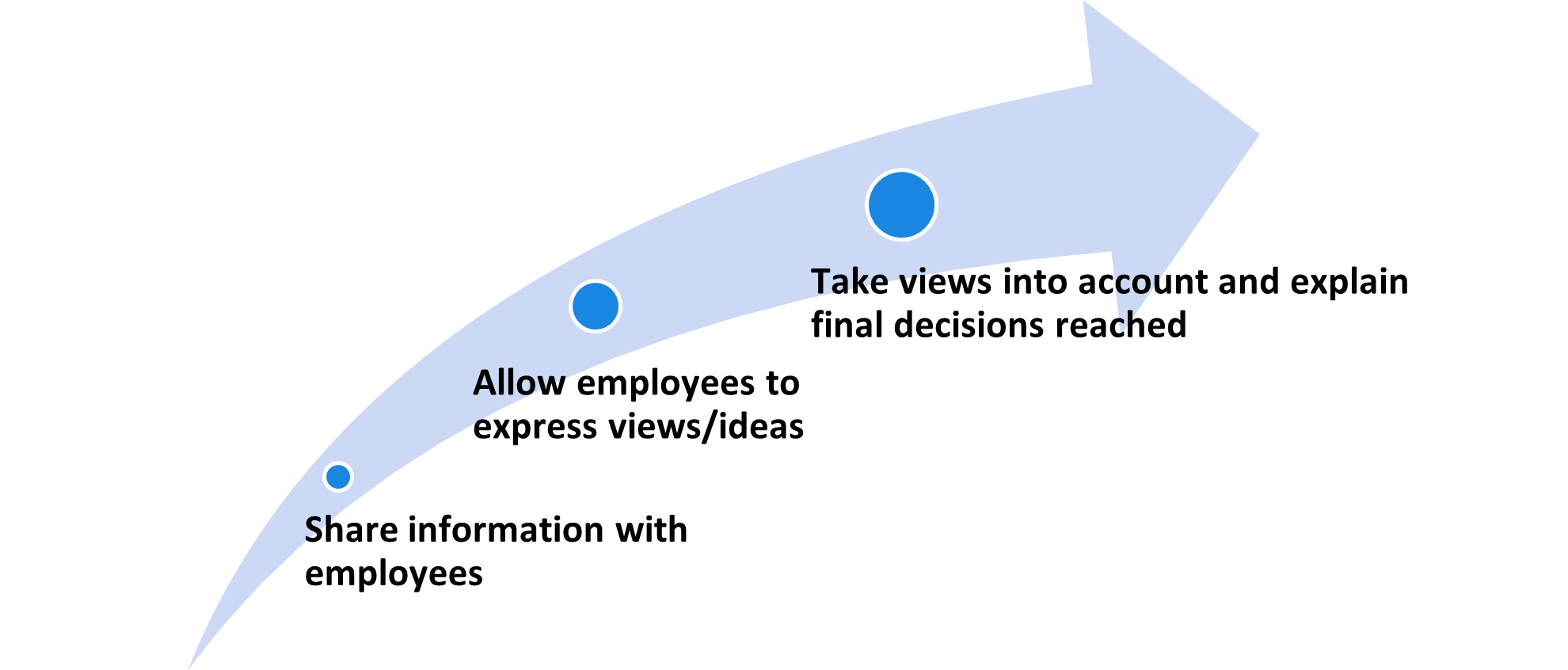
Watch this short video about Safety consultation at work, and how the WHS consultation process assisted the employees in this workplace.
Consultation - an employer's responsibility - (02:23)
Text transcript
Learning Activity 10
To complete this activity, read and respond to Activity 10 questions in your document Learning activity worksheet.
Bring this document with you to your next face-to-face class to discuss with your teacher and fellow students.
2. Raising WHS issues

As you saw in the video, being involved in WHS at work creates a safer and more satisfying work experience for everyone.
Each workplace will have a procedure or a process to follow for raising and resolving WHS issues in the workplace.
Let’s take a look at the process Safetwork uses to resolve any WHS issues.
Open the Resolution of health and safety issues from Worksafe; download and read through the Issue Resolution Flowchart.
2.1. Clear communication
When attending WHS meetings, speaking up about WHS issues or being asked your opinion of WHS in your workplace, always be mindful of your audience and the impact your words will have.

- Is it appropriate to bring up this issue in this meeting?
- Has this issue been raised before and not been received well by others?
- How can I stress the importance of dealing with this issue without yelling or becoming angry?
- Who can support me to raise this issue?
- What solutions can I suggest for dealing with this issue?
If
you were asked to report on a sensitive issue such as witnessing bullying or
discrimination in your workplace, make sure you follow the VPS values of
honesty, respect, impartiality and integrity.
| Do | Don't |
|---|---|
| Provide accurate and factual information about what you observed. | Omit any important details. |
| Relay specifics, about times, dates, people involved and what was said/observed. | Repeat hearsay or stories you have heard. |
| Speculate on the reason for the incident. | |
| Attempt to lay blame or give your own opinion. |
2.2. Support for more complex WHS issues

Some WHS issues may be straightforward, easier to discuss and resolve such as broken furniture or poor lighting etc. Other WHS issues such as discrimination or workplace bullying may be more complex and difficult to raise.
In the case of an incident involving workplace safety (which includes bullying and harassment), you should follow the established process and promptly report the incident by contacting the authorised WHS officer for your organisation using the correct channels.
People who can assist you to raise complex issues such as discrimination or sexually inappropriate behaviour at work, may include:
- Your Health and Safety representative (HSR)
- A supervisor you trust
- Risk and compliance officer
- Union representatives and OHS specialists
- Worksafe representatives
- Fair Work Australia, Ombudsmen.
As you saw in the DET OHS flowchart, when issues are unresolved through an organisation’s internal process, there are external bodies who are able to mediate and assist.
WorkSafe Victoria - https://www.worksafe.vic.gov.au/resources/discrimination-health-and-safety-grounds
Fair Work Australia - https://www.fairwork.gov.au/horticulture-showcase/workplace-health-safety
Australian workers Unions - https://www.awu.net.au/vic/our-branch/safety/
3. Eliminate workplace hazards
The goal of any organisation is to eliminate workplace hazards completely, however this is not always possible and therefore a system for controlling risks in the workplace is used, called the hierarchy of control.
The hierarchy of control is a step-by-step approach to eliminating or reducing risks. The strategies at the top of the pyramid are more effective and therefore prioritised over those at the bottom.
Watch
this video or read through Worksafe Victoria’s webpage, both describing
how the hierarchy of control works in various workplaces.
3.1. Scenario

Sam works in a busy finance team and her job is to check all figures for the weekly and monthly reports before they are sent to management.
This means that Sam is on her computer for most of her day. She complains of sore eyes, headaches and wrists.
Consider:
1. What are the risks for Sam if she continues in this job?
- Physical?
- Mechanical?
- Psychological?
- Biological?
- Chemical?
2. Using the hierarchy of control system, which of
the five controls would be most effective for Sam to prevent injury?
3. Suggest three control measures that could be
implemented to assist Sam and prevent any injuries from occurring.
3.2. Controlling psychological hazards
As we saw earlier, hazards that may cause psychological injuries, may not be as obvious as physical hazards, but they still need to be eliminated or controlled.
Watch this video – What are work related factors? by Worksafe Victoria.
What are work related factors? - (03:42)
Text transcript
3.3. Reflecting on work related factors
The video on the previous pages stated that employees need –
‘challenging tasks to maintain their motivation and to develop new skills, but they also need to be able to cope.’
It mentions a number of common work factors that can become hazards if not managed correctly.
Reflect on these common work factors in relation to your work role. Use the following checklist to help you.
| In my work role, I ….. | True | False |
|---|---|---|
| have a lot of control over my job demands | ||
| have high and low job demands | ||
| am provided with good support | ||
| have good environmental conditions | ||
| have good professional relationships with colleagues | ||
| have good recognition of my work | ||
| understand how my work impacts the organisation | ||
| can see how justice is carried out at work | ||
| feel remote and isolated | ||
| know who I can contact for support |
If you ticked more False than True and/or if you answered False to the last statement, then you may need to seek some assistance.
People who can assist you might include:
- your manager
- work colleagues
- HR person
- HSR
- a close friend
- employee assistance program (EAP)
- a counsellor
- a Worksafe officer.
Remember creating and maintaining a healthy psychological workplace is everyone’s responsibility.
This completes the final topic, Participating in WHS processes. Now complete the learning activity below to check your knowledge.
Learning Activity 11
To complete this activity, read and respond to Activity 11 questions in your document Learning activity worksheet.
Bring this document with you to your next face-to-face class to discuss with your teacher and fellow students.